This glossary serves to familiarize yourself with the terminology that will be used in the first module.
Analog frequency
Noun
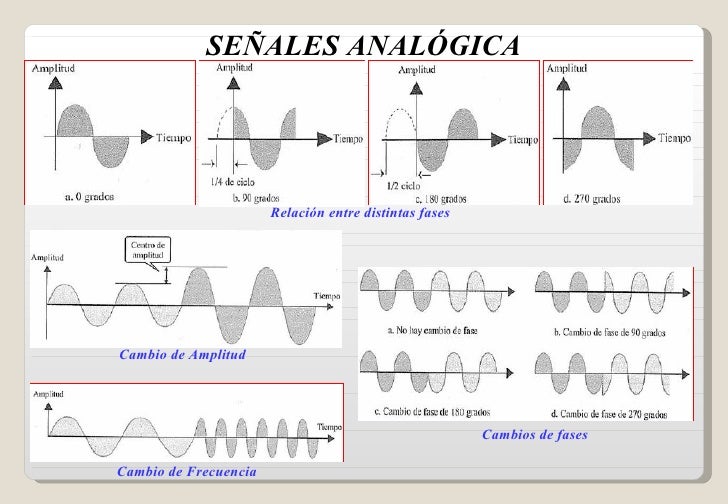
In an electrical signal, the voltage, current, or frequency of the signal may be varied to represent the information. Any information may be conveyed by an analog signal; such a signal may be a measured response to changes in a physical variable, such as sound, light, temperature, position, or pressure.
Example: An example of an analog electronic system is the loudspeaker, which is used to amplify sound so that it can be heard by a large audience.
es: Frecuencia analógica
Analog signal
Noun
An analog signal is a type of signal generated by some type of electromagnetic phenomenon; which is representable by a continuous mathematical function in which its amplitude and period are variable as a function of time.
Example: An example of an analog electronic system is the loudspeaker, which is used to amplify sound so that it can be heard by a large audience.
es: Señal Analógica
Continuous-Time Signals
Noun
A continuous-time (CT) signal is a function, s(t), that is defined for all time t contained in some interval on the real line. For historical reasons, CT signals are often called analog signals.
Example: The electrical signals derived in proportion with the physical quantities such as temperature, pressure, sound etc. are generally continuous signals. Other examples of continuous signals are sine wave, cosine wave, triangular wave etc.
es: Señales de tiempo continuo
Discrete-Time Signals
Noun
A discrete signal or discrete-time signal is a time series consisting of a sequence of quantities.
Unlike a continuous-time signal, a discrete-time signal is not a function of a continuous argument; however, it may have been obtained by sampling from a continuous-time signal.
Example: For example, if you were monitoring the temperature of a room, you would be able to take a measured value of temperature at any time.
es: Señales de tiempo discreto
Force
Noun
strength or energy as an attribute of physical action or movement.
Example: An automobile responding to an applied force f from the engine and to a re-tarding frictional force pv proportional to the automobile's velocity v.
es: Fuerza
Independent variables
Noun
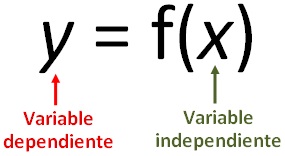
The independent variable, also called explanatory, is one whose variation also causes a change in the dependent variable or explained variable.
Example: The independent (VI) is the one that changes or is controlled to study its effects on the dependent variable (VD).
es: Variable independiente
Signal energy
Noun
The terms signal energy and signal power are used to characterize a signal.
They are not actually measures of energy and power. The definition of signal
energy and power refers to any signal (tx ), including signals that take on
complex values.
Example: An example of an Energy signal is a time-limited audio, since its amplitude tends to 0 when | t | → ∞.
es: Energía de señal
Signals
Noun
Signal is a function that conveys information about a phenomenon. In electronics and telecommunications, it refers to any time varying voltage, current, or electromagnetic wave that carries information.
Example: For example, a speech signal may be represented as an amplitud function
of time and a picture as a brightness function of two spatial variables.
es: Señales
Simple circuit
Noun
A simple circuit definition is a closed loop of a conductor that electrons can travel around, usually consisting of a power source (a battery, for example) and an electrical component or device (like a resistor or a light bulb) and conducting wire.
Example: An electric circuit is a connection of components that can conduct electric current. ... Every circuit is designed to deliver power to one or more loads. For example, in a boombox the power goes to the speakers. Similarly, the power in a lamp goes to the light bulb.
es: Circuito simple
Systems
Noun
A set of things working together as parts of a mechanism or an interconnecting network.
Example: For example, the case of a circuit electrical, which constitutes the system in which the input and output signals are the current and
the tension.
es: Sistemas
Voltage
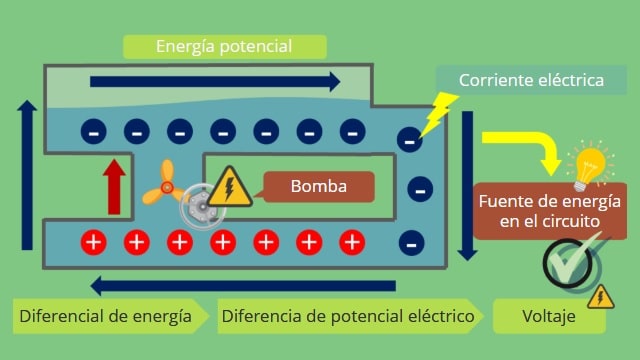
It is the magnitude that accounts for the difference in electric potential between two determined points.
Example: Electric batteries can be another everyday example of how to represent voltages, this represents a total of +1.5 volts. In addition to the car battery that generates a total of 12.5V or our neurons, -75 millivolts.